

The Middle Manager's Irreplaceable Job
change, AI, and the bits nobody plans for

The Take
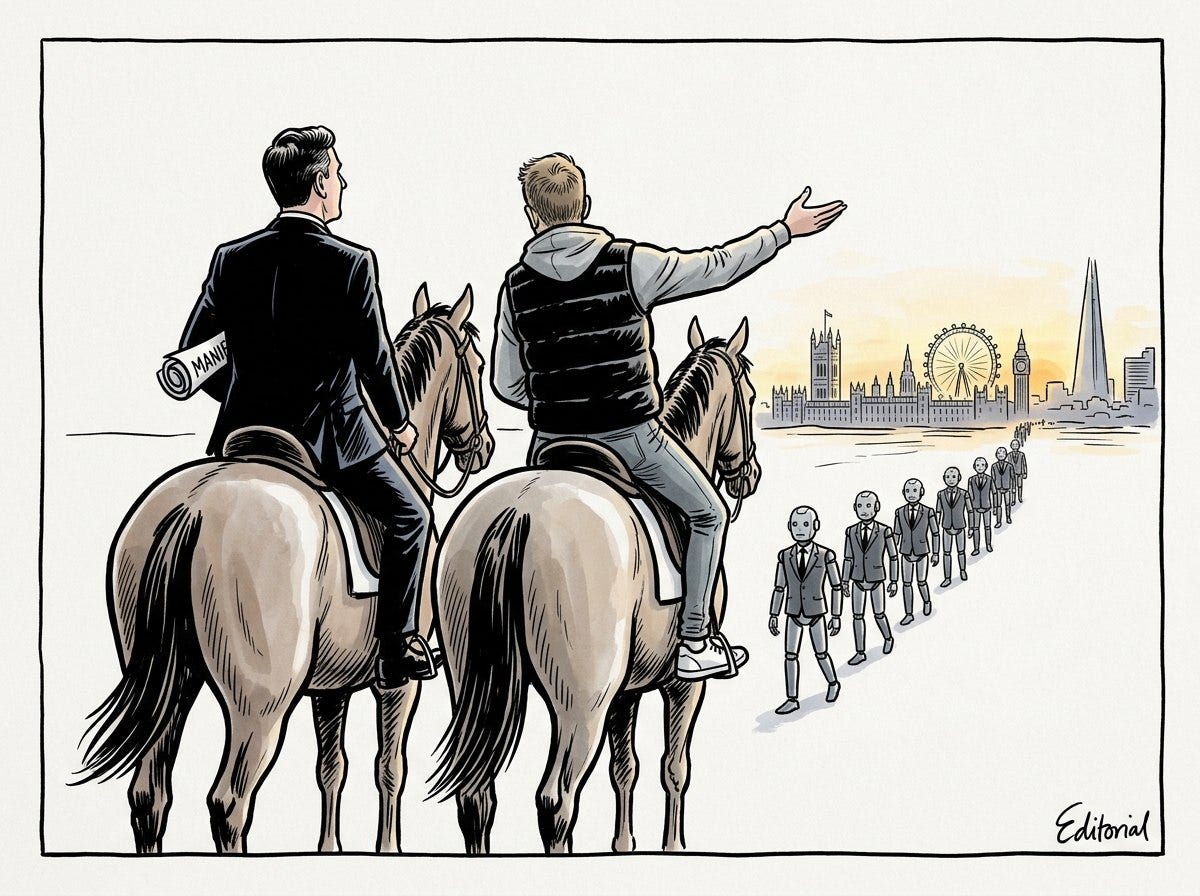
Jack Dorsey wants to fire your middle managers and replace them with a machine.
Not literally, perhaps. But that is the direction of travel. His model at Block strips out the traditional management layer and replaces it with what he calls a “company world model,” an AI system that tracks decisions, maps bottlenecks, and generates task backlogs based on actual customer data rather than a product manager’s instinct. Hierarchies, he argues, existed to route information. AI does that faster and without the politics. So why keep the layer?
It is a clean argument. And it is wrong in one important place.
The logic holds for the information problem. Middle managers have always spent a significant portion of their time doing things that should not require a human being. Status meetings. Chasing updates. Translating what the executive said into something the team can act on. Summarising progress for people who were too busy to read the original. If AI can absorb that load, I am not against it. That work was never the point of the role.
But there is another kind of work that happens in the middle of an organisation, and it has almost nothing to do with information routing. It is the conversation a manager has on a Tuesday afternoon with someone who is quietly falling apart. It is reading the room when a team has just been told about a restructure and the words coming out of people’s mouths are not the words that matter. It is knowing that one person needs to be pushed and another needs to be left alone this week. It is making someone feel that their contribution is seen, that the work they did last quarter was n hi ot just absorbed into the machine and forgotten.
That is not bandwidth management. That is human judgment applied to human beings. And that is not something a model trained on workflow data can replicate.
Dorsey’s structure, with its Individual Contributors, Directly Responsible Individuals, and Player-Coaches, is not without merit. Cleaner accountability, shorter cycles, more direct ownership. There is genuine value in that design. The Player-Coach role in particular is interesting because it tries to hold onto mentorship and human development while removing the administrative scaffolding around it.
But the structure assumes the people inside it do not need much from the middle layer other than clarity and coordination. That assumption holds when things are going well. It does not hold during change.
I have spent enough time inside organisations to know that the moment a significant change programme lands, the middle of the house is where everything either holds or falls apart. Not in the boardroom where the strategy was designed. Not on the front line where people are doing the daily work. In the middle, where someone has to translate the intention into something people can actually live with.
Change lands on paper. We make it land in people, not AI.
That work requires empathy. It requires the ability to sit with ambiguity and still reassure someone who is frightened. It requires reading what is not being said. An AI model will tell you that productivity metrics held steady through the transition. It will not tell you that three people on the team have emotionally checked out but are still turning up because they do not know what else to do.
The question is not whether AI can handle the logistics of middle management. It clearly can handle significant portions of that. The question is whether organisations can afford to remove the human presence that holds the emotional centre of a team together when things get difficult.
My position is this: AI should take the administrative weight off managers so that managers can do the human work properly. That is the right division of labour. What it should not do is replace the manager entirely and leave people without someone who will notice when they are struggling.
Speed and efficiency are not the only things an organisation runs on. Belonging, trust, and the sense that someone is paying attention, these are not soft extras. They are the conditions under which people do their best work. If you remove the humans responsible for maintaining those conditions, no world model will rebuild them for you.
The Quiet Part
Andy Burnham is back in Westminster. UK Politics still remains the talk of town. And quietly, in boardrooms and project offices across the UK, people are watching and wondering what it means for public sector change programmes already in flight.
This is not a political endorsement. It is an observation about timing.
Any shift in political direction brings its own disruption. Funding assumptions change. Policy priorities shift. Organisations that have shaped transformation programmes around the current government’s agenda will need to look again at where the incentives sit and which projects have a future in a different political climate.
The smart move right now is not to panic and not to pretend nothing is happening. It is to get a clear view of which parts of your change portfolio depend on political continuity and which are structurally sound regardless of the personality in power.
Change projects are not immune to what happens in Westminster. People inside organisations feel the national mood. Leadership uncertainty at the top of the country creates permission for uncertainty everywhere else.
Stability is coming I hope. We do not know yet whose version of it. In the meantime, any organisation with change in flight should be asking a simple question: if the policy environment shifts in the next twelve months, what does that mean for what we are building?
That is not pessimism. That is good change management.
Build Log
Spent some time last week on JIDI, working through a few persistent issues that needed attention. Also fixed some errors in Frank 2.0 that have been sitting on the list longer than they should. Nothing dramatic to report, but both are in better shape than they were last week Monday. Sometimes the week’s work is just clearing the technical debt that builds up when everything else is moving fast. It doesn’t make the highlight reel, but it matters.
Sign-off
I completely forgot Father’s Day was coming. Genuinely, completely forgot. Saturday was full, the week was full, and Sunday arrived before I had accounted for it. Then Olivia, Sophia, and Amelia appeared with a delicious breakfast and a pile of handmade cards, and Sharon had quietly made sure the whole thing happened without me noticing a thing. That is a kind of leadership I genuinely admire. To my girls and to Sharon, thank you. I didn’t deserve the surprise but I was very glad of it.